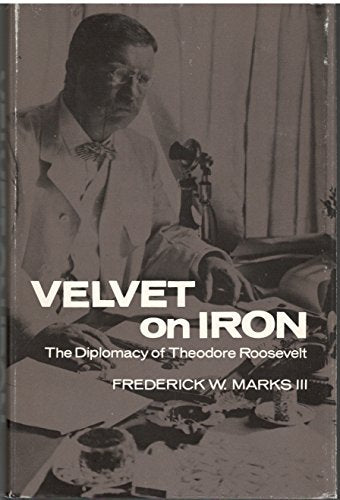

Velvet on Iron: The Diplomacy of Theodore Roosevelt
Couldn't load pickup availability
About this book
Velvet on Iron: The Diplomacy of Theodore Roosevelt by Marks III, Frederick W.. Hardcover edition. ISBN: 9780803230576.
No president in American history has suffered a stranger fate at the hands of posterity than Theodore Roosevelt. The world leader who achieved international recognition and popularity in his own time as a man of peace (he was one of only two presidents awarded the Nobel Peace Prize) is submerged in the image of the Rough Rider, the “Bully” fighter, whose enthusiasm for a fight or a hunt was unrestrained by humanitarian or other concerns. The kindest criticism of Roosevelt holds that by good luck and good advice he was able to avoid disaster; the unkindest that he was an international adventurer who posturing misled may an admirer. Moreover, the apparent paradox implicit in his famous slogan, “Speak softly and carry a big stick,” has confused scholar and layman alike, and that confusion has been abetted by the seemingly contradictory impulses of his personality. Frederick W. Marks III, drawing upon archival and manuscript materials in five countries, as well as numerous primary and secondary sources, rebuts, point by pint, the myths and misconceptions that have given rise to this distorted and confused image. Arguing that Roosevelt can be understood only in the context of his time and that the whole of his diplomatic record provides the key to understanding its individual parts, he reconstructs in careful detail the man, his time, and his record, and, in so doing, allows us to see Theodore Roosevelt whole. Given the received opinion concerning the man and his presidency and the nature of contemporary political attitudes, Mark’s interpretation of Roosevelt’s conduct of foreign affairs will undoubtedly prove highly controversial, yet his argument, buttressed as it is by a wealth of source material, deserves serious consideration by those concerned not only with the accuracy of historical judgment but also with the successful conduct of foreign relations.