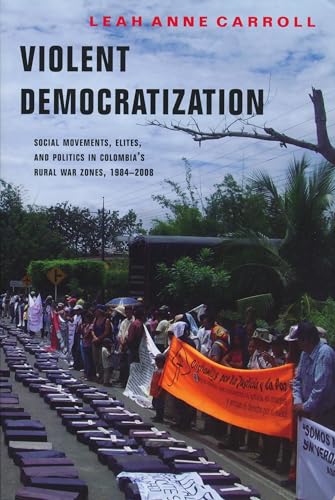
Violent Democratization: Social Movements, Elites, and Politics in Colombia's Rural War Zones, 1984-2008 (Kellogg Institute Series on Democracy and Development)
Couldn't load pickup availability
About this book
Violent Democratization: Social Movements, Elites, and Politics in Colombia's Rural War Zones, 1984-2008 (Kellogg Institute Series on Democracy and Development) by Carroll, Leah. paperback edition. ISBN: 9780268023034.
In Violent Democratization, Leah Anne Carroll analyzes peasant and rural worker mobilization, as well as elite reaction, in Colombias war zones over a period of twenty-five years and across three regions. Due to Colombias long history of electoral democracy coinciding with weak state institutions, armed insurgencies, strong social movements, and violent responses from elites and the state, Carroll presents Colombia as a clear-cut national case of "violent democratization." Relying primarily on her interviews with leftist and social movement activists, elected officials, and some elites, as well as on electoral data and archival sources, Carroll reconstructs the political history of key county governments, providing a detailed account of the struggles for local power between elites, on the one hand, and rural agriculturalists and workers, on the other. Carroll analyzes the ways in which the tactics of social movements and elites shifted as national political trends moved from greater political freedom, rapid decentralization, and peace overtures toward guerrilla groups characteristic of the 1980s and early 1990s, to the reversal of these trends and the major escalation of armed conflict and U.S. military aid thereafter. In all three regions, peasant, worker, and neighborhood movements, aided by leftist elected officials, initially gained significant victories. Their successes provoked a violent elite counteroffensive against activists, involving both military and elite-supported paramilitary forces. In response, however, a second wave of activism promoted human rights demands and sought international support to confront the violence of both the Right and the Left. Within these commonalities, Carrolls three regional case studies (Uraba, the Middle and Lower Caguan Valley, and Arauca, producing bananas, coca, and oil, respectively) demonstrate how geographical location and the unique characteristics of the activist movements and regional elites (plantation owners, oil companies, cattle ranchers, and the military and paramilitary forces themselves) shaped each movements tactics, unity, and success.