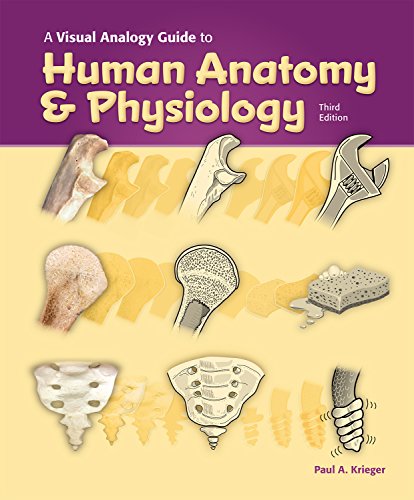

Visual Analogy Guide to Human Anatomy & Physiology
Couldn't load pickup availability
About this book
Visual Analogy Guide to Human Anatomy & Physiology by Krieger, Paul A.. loose_leaf edition. ISBN: 9781617316265.
The Visual Analogy Guides to Human Anatomy & Physiology, 4e is an affordable and effective study aid for students enrolled in an introductory anatomy and physiology sequence of courses. This book uses visual analogies to assist the student in learning the details of human anatomy and physiology. Using these analogies, students can take things they already know from experiences in everyday life and apply them to anatomical structures and physiological concepts with which they are unfamiliar. The study guide offers a variety of learning activities for students such as, labeling diagrams, creating their own drawings, or coloring existing black-and-white illustrations to better understand the material presented. Features: 1. Covers all major human organ systems and includes sections on basic cell biology and histology. 2. Visual analogies, mnemonic devices, conceptual illustrations, and labeling and coloring exercises help students learn the details and concepts of human anatomy and physiology. 3. Analogies and other key concepts are presented in a modular format with the text on the even-numbered pages and illustrations and analogies on the facing odd-numbered page. 4. Large, high-quality, original illustrations are presented in two colors. Students may choose to color these illustrations to aid their comprehension of the material. 5. Helpful icons throughout each book identify microscopic structures, study tips, and two- and three-dimensional structures. 6. For fill-in-the-blank sections, the answers are found on the facing page. This allows students to learn not only though self-quizzing but also through the process of rewriting the correct information in the labeling areas.