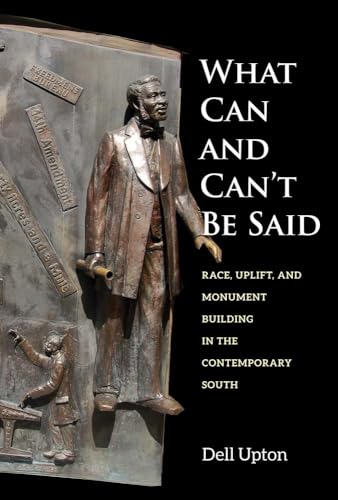
What Can and Can't Be Said: Race, Uplift, and Monument Building in the Contemporary South
Couldn't load pickup availability
About this book
What Can and Can't Be Said: Race, Uplift, and Monument Building in the Contemporary South by Upton, Dell. Hardcover edition. ISBN: 9780300211757.
“A noted authority on architectural history and American cities . . . engages with the ongoing debate over interpretations of race in public art.”—Glenn T. Eskew, American Historical Review “Thorough, insightful, and of great use in comprehending the vital role that monumental art can and does play in American culture.”—Choice An original study of monuments to the civil rights movement and Black history that have been erected in the American South over the past three decades, this powerful work explores how commemorative structures have been used to assert the presence of African Americans in contemporary Southern society while showing how the construction of such monuments frequently exposes the myth that racial differences have been overcome. Examining monuments whose creation has been particularly contentious, from the Martin Luther King, Jr., National Memorial in Washington, D.C., to more obscure memorials such as the so-called "multicultural monument" in Bowling Green, Virginia, Dell Upton shows that monument builders must contend not only with varied interpretations of the African-American past but also with the continuing presence of White supremacy—not only in its traditional forms but also in the subtler, more recent assumptions that Whites are neutral arbiters of what is fair and accurate in such monuments. Upton argues that Southerners, White and Black, share a convenient fiction—a “dual heritage” that allows them to acknowledge the Black past without relinquishing cherished White historical mythologies. In his conclusion, Upton considers how these two pasts might be reimagined and memorialized as a single Southern American history.