Win Your Child Custody War: Child Custody Help Sourcebook
Couldn't load pickup availability
About this book
Win Your Child Custody War: Child Custody Help Sourcebook by Hardwick, Charlotte. paperback edition. ISBN: 9781587470844.
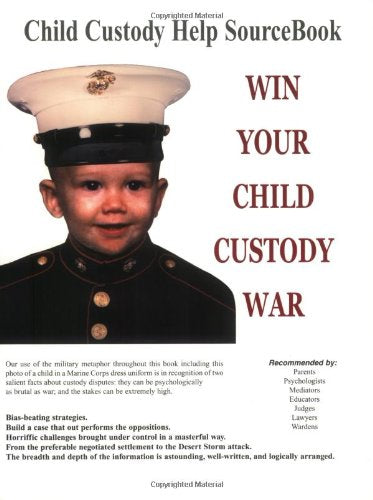
Win Your Child Custody War, is impressive in both its depth and its breadth. It is a practical "how-to" book, but it is extremely well researched and covers every imaginable custodial issue. No one involved in a custodial battle should enter the courtroom without first reading it. With this book everybody wins--mothers, fathers, and especially the children. The use of the military metaphor throughout (including a photo of a child in a Marine Corps dress uniform on the cover) is in recognition of two salient facts about custody disputes: they can be psychologically as brutal as war; and the stakes can be extremely high. Yet, the book demonstrates with details and documents, that negotiations are possible, and if the welfare of the child has the highest priority, both sides can win.I would advise you, however, NOT to go into court without having first read this remarkable book. Over the course of 640 triple-columned pages, Hardwick shares her personal experience and her painfully accumulated knowledge on just about every conceivable aspect of the child custody wars while guiding the reader toward a powerful strategy. If you dont have this book you are likely to be overmatched; indeed if your attorney doesnt have this book, he or she is likely to be overmatched. In fact, I would say that the first thing you should do after reading the book yourself, is buy a copy for your attorney and somehow persuade him or her to open the pages and to start reading--anywhere in the book. I promise you your attorney will learn facts, ideas, strategies new to him or her. The expanse and depth of the material presented here quite frankly amazed me. This extensive tome constitutes an entire course not only in child custody disputes but in human psychology, parenting, and the law itself. Some items: There are 91 pages citing, summarizing, quoting from, and referencing relevant cases and decisions.There is a detailed guide on how to negotiate and what conflict resolution is all about;a chapter on how to handle discovery and depositions; another on judges, what to expect from them and how you might get a good one or avoid a bad one; theres guidance on what to expect in court and how to present yourself and your case; how to select an attorney; what your case is likely to cost and how to discover the assets of your adversaries, including (this floored me) hidden assets such as "Overpayments to the IRS". You will learn about how much you can expect to pay or receive in child support, and again how to gauge assets, including hidden income such as "excessive deductions on paychecks" --a nice dodge which amounts to loaning Uncle Sam the money until tax time! You will also: --Discover how to handle psychologists and other "evaluators" and influence them to your advantage. For example beware of the "halo effect." (Have your side evaluated by the psychologist first to secure that effect.) --Understand what psychological tests can be given and what they can mean in the dispute. Sometimes the judge makes the court-ordered decision of a professional binding, so that "you have in fact a new judge." --Appreciate the role of other experts, what they can and cannot do to further your case, and how to evaluate and get a reliable expert who will make an effective witness.--Learn the value of keeping a detailed log of everything pertaining to your case and its possible use as documentation. Hardwick presents this with some tips on how e-mail and computer files can come back to haunt you if you share the wrong information, even anonymously or through the assumption of an Internet moniker.--Become knowledgeable about lie detectors and their use and misuse and the reach of DNA testing.--Know which problems or accusations are issues and which are non-issues in the eyes of the law. For example, child endangerment is an issue; a "blended" family is not. Physical abuse is an issue; false accusations may or may not be. --Be introduced to the infamous Parental Alienation Syndrome (PAS) in which one parent tries to alienate the child from the other parent through lies and distortions. PAS includes "The Grand Lie" in which one side falsely accuses the other of child sexual abuse, a charge that is hard to become completely free of, regardless of the truth of the accusation.Hardwick even includes some humor with eleven ways on how to know "Youve Been in Court Too Long" (from Dean Hughson). If this isnt enough there is a presentation of ingrained psychological strategies that you might use or encounter such as the famous "Tit for Tat" from game theory or the sneaky "Tranquilizer" who lulls you to inattention and then takes advantage.There is a Glossary of Terms and a detailed Index as well as a lot information on resources throughout. Theres even a chapter on lies and how to correct them (should you be the liar!).The mass of information and the sharp, sound guidance contained herein really amount to a post graduate course in child custody disputes. Even so