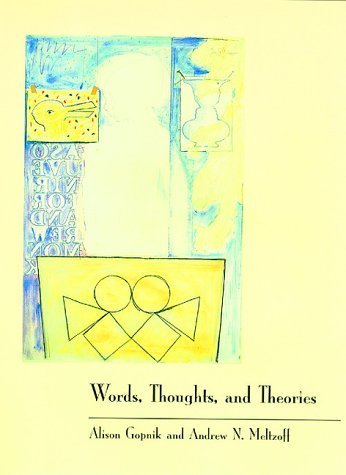
Words, Thoughts, and Theories (Learning, Development, and Conceptual Change)
Couldn't load pickup availability
About this book
Words, Thoughts, and Theories (Learning, Development, and Conceptual Change) by Gopnik, Alison. hardcover edition. ISBN: 9780262071758.
Words, Thoughts, and Theories articulates and defends the "theory theory" of cognitive and semantic development, the idea that infants and young children, like scientists, learn about the world by forming and revising theories, a view of the origins of knowledge and meaning that has broad implications for cognitive science. Gopnik and Meltzoff interweave philosophical arguments and empirical data from their own and others research. Both the philosophy and the psychology, the arguments and the data, address the same fundamental epistemological question: How do we come to understand the world around us? Recently, the theory theory has led to much interesting research. However, this is the first book to look at the theory in extensive detail and to systematically contrast it with other theories. It is also the first to apply the theory to infancy and early childhood, to use the theory to provide a framework for understanding semantic development, and to demonstrate that language acquisition influences theory change in children. The authors show that children just beginning to talk are engaged in profound restructurings of several domains of knowledge. These restructurings are similar to theory changes in science, and they influence childrens early semantic development, since childrens cognitive concerns shape and motivate their use of very early words. But, in addition, children pay attention to the language they hear around them and this too reshapes their cognition, and causes them to reorganize their theories.